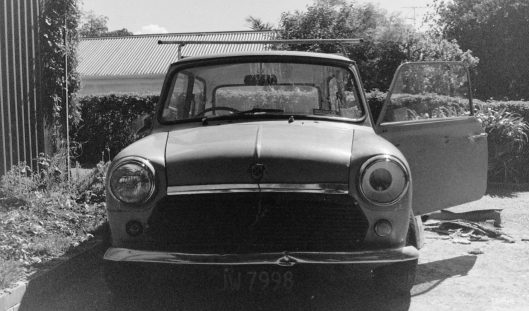
 Roughly now 15 years ago was the first time I met JW7998. I was working at one of the local servos (petrol station) one day when JW7998 came rolling in. By rolling in, I mean literally rolling in. The owner,a man probably around my current age had run out of petrol and had coasted down the road before jolting to a stop outside the front.
We got talking and by the conclusion of our discussion I was handing him $50, and he was handing me the pink slip (well, actually, just keys – we don’t do pink slips here) to his car. Two minutes later he ran back inside asking if it was ok if he took his boys seat (toddler was with him) and petrol can. I said sure.
At the end of my shift I pushed it by the bins, raced home in my usual ride and came back with a friend to both drop me off and see that I make it home. As in todays photo, IW7998 was short one eye. It was dark. To avoid possible legal trouble I took the back way home. The back way was part gravel. After a fun and slightly cautious drive, I made it home in one piece. JW7998 made it home in the same shape it rolled in on, which is possibly better than could be expected!
JW7998 was not my first project car, but it was my first major project car. Within weeks I had stripped it down to a bare shell. I welded up holes, repaired panels, designed and welded up a new bodykit. I then rebuilt the engine, reupholstered the seats and interior, made a new wiring loom, added central locking. Back outside I modified the suspension – more welding. Finally a long prep and paint in an almost fluro yellow.
Even now, after many other projects, I reflect on JW7998 as my favourite completed project. Every now and then I kick myself that I didn’t keep it longer (Mini sale prices have gone up tenfold since I sold it).
I drove it around for something like a year, maybe a year and a half, and was once again bitten by the car building bug – so it was time to say goodbye. I sold it to a young lad, his first car! – he must have been stoked.
Writing this up today I did a quick plate check on JW7998 (whom received a different, new plate when I had completed my build). I was happy to see that for many years after my ownership JW7998 was still on the road (so many of the old 70’s cars are long gone now). I was then surprised even more to see it had since been shipped off overseas to live elsewhere.
Who knows. Maybe JW7998 and I will cross paths again one day…
 A trip up One Tree Hill to see the lambs proved to be a bit of failure with the Olympus E500 this weekend. I think the combination of fast running lambs, overcast light and long zoom tested the old DSLR beyond its comfort zone. Upon opening at home, the majority were blurry. Never mind, perhaps I’ll try the Nex one weekend soon!